Friday, February 29, 2008

Crossbills and crooks

School has been very interesting, with diverse topics in every class. I am currently studying Heidegger, mangrove swamps, the Great Depression, military dictatorships in Argentina and Uruguay, and other things I never knew anything about.

This has been another week of staying indoors, but it is getting warmer again – the last snowfall is gradually melting away again, and next week, Insh’Allah, I should be able to bicycle. A rather bird-poor week, obviously, although a flock of white-winged crossbills Loxia leucoptera did hang out in front of the “dark hole of despair” condo:


This year is full of potential for voters to influence the future. Alaska representative Don Young (R) is being investigated for fraud, and has spent nearly a million dollars of his campaign funds on lawyers to fight off corruption charges. Don Young ranks especially high on my list of despicable people (he told me in a Sitka public meeting that the Alaska rainforest grows back in less than 100 years, and that less than 1% of the Tongass had been logged!), so if you are registered to vote in Alaska, you should check this guy out before letting Don Young continue his 35-year crusade to destroy the environment in Alaska! According to the AP, when Don Young was asked about his spending of campaign money on legal fees, he said this:

“Everybody wants change, what is change?”


Tuesday, February 19, 2008

Notes from the dark hole of despair

It is now raining, which is slowly turning the city into a patchwork of slush, ice and bare ground. Everyday there is a little bit more bare ground, but still not enough road is clear to go bicycling without studded tires (of course, as Tom justly pointed out, I am just weak; this crazy woman has no problem with a little ice and snow).

I have largely been an indoor creature lately, studying, vegetating in Jad’s condo, going to downtown bars (quite an adventuresome thing to do, at times), etc. I did restart running (I had been injured since October), but that is also indoors at this time and rather slow. With some luck, I might be able to go to the National Guard marathon trials in May. I even took up indoor birdwatching, looking at passing eagles, siskins, redpolls, chestnut-backed chickadees, Steller’s jays, magpies, and even a heron, through windows at the condo and the university. I took this picture of a Steller’s jay from the condo:


In the same mood of winter depression, we are now calling Jad’s condo “the dark hole of despair”. It really isn’t so bad, but I like it because I had been reading a lot of Kierkegaard when Ian came up with the name.

A few days ago, I did briefly go outside. Ian and I went out to the range to shoot a flak jacket (it stopped a .40 cal round – not bad), and start a fire by rubbing stick together. We had seen a guy do it on television (I know…) and it looked rather feasible, so we went out there and tried. It was simply impossible to find anything dry. Even the relatively dry wood we extracted from the rotting core of living trees (through opening between the roots) turned out to be too wet. Also, the bow just didn’t seem to work; it kept flipping the stick into Ian’s face or slipping and achieving nothing. We gave up.


A good thing that I did was vote in the primary elections for the first time. Primaries are complicated, and usually Alaska only has a symbolic role to play, but this year every state counts. In the American system, registering for a party is free and non-committing, and registered voters basically get to vote twice: one for nomination and once for president. Because we already know with 90% certainty that all Alaska votes will result in one Republican vote in the presidential elections, the primary votes are more important than the presidential votes – especially for Juneau democrats, because of the way that delegate numbers are assigned. So I registered, and went to vote at the primaries. The primaries were a crazy affair, with 1200 registered democrats showing up in spite of a cold, windy day with two feet of snow on the ground. Obama, the candidate I had turned up to vote for, got almost three-quarters of the democratic vote in Juneau (same as the state overall of 74%). That means there were about 900 of us there to vote for him. Polls for the primaries are an old-fashioned, simple, and emotional affair compared to the presidential elections.

Democracy at its best…

Monday, February 4, 2008

Enough snow!

Many people are enchanted by snow – I honestly would rather it were summer already. I cannot wait to bicycle to the university, walk around in the mountains with plenty of daylight and no ice or avalanches, and step outside without first wrapping multiple layers of fleece over every part of my body. Many days were bitterly cold, and hiking was painful and short, such as a trip out on Mendenhall Lake to check out the icebergs up close:


I thought my nose was going to freeze off on that one hour mini-adventure.

I then went back up the side of Mount Juneau to look for the goats, with Ian and Mac. It was a fun hike even though I was not wearing crampons and I kept sliding. I just tried to stay off the ridge where it was most icy and dangerous. The photo below is from the bottom of the trail that we started from. Ian and Mac are standing in front of an old gold mine tunnel.


I went back to Mendenhall flats, and once again I was absolutely freezing. This time I didn’t see any unusual birds at all, so I just walked around in the snow with Ian.


Most of my time is taken up by school, though, and some of my classes are very interesting. In decreasing order of interest they are: introduction to oceanography, history of the US II, Spanish conversation, literature and the sense of place, poetry studies. Of course, it isn’t so much the topic that makes a class more interesting than another, as the instructor and material.

And Jad – the pilot who owns the place that Ian and I are sleeping on - just got back this morning. For Ian it is bad news because now he has to sleep on the couch. As for me, I hardly know anyone in Juneau so I am happy to have another familiar face around. So far I only know a handful of Army buddies, and Roman, another Sitka “expatriate.”

As far as long-term plans are concerned, I have some vague ideas which are subject to change of course. I am planning to go to Sitka over spring break (late March) and look at perhaps finding a chunk of land that I could buy. Of course, everything there is VERY expensive, so I may or may not be successful in that particular endeavor.

Tuesday, January 22, 2008

Schoolwork and a little bit of sunshine

School has been a lot of work, but I did escape for three very short hikes over the weekend to take advantage of unusually good weather.

First, I went to a couple of beaches with Ian and Mac. It is a bit strange to go to the beach when there is snow on the ground, but I really enjoyed it. I even found a few ferns. I am looking forward to start studying botany when there are more plants around.


I then went for a walk out the mudflats by the airport. I didn’t see any rare birds (apparently, there might be a McKay’s bunting out here), but I did find some brant and a shoveler, although they shouldn’t be here in the winter. I was also very, very lucky to see a pod of orca whales out in the distance, just beyond a group of scoters that I was unsuccessfully trying to identify. I also took the mandatory bald eagle photo. Yes, I am a little sick of bald eagle pictures, but after all – they are pretty cool looking.

I then went with Mac to look for mountain goats on the side of Mount Juneau. It was quite a fascinating trip. Mac knows a lot about the local area (he grew up here), and about the mountain goats (he's been paying close attention to their movement for a long time). Mountain goats are - to my surprise - mostly a forest-dwelling animal here. They spend most of the year in forested slopes close to cliffs over which they can escape. It was odd to see mountain goat tracks, feces, and sleeping spots all over the forest, and to need crampons to negociate ice-covered ridges in the trees!


.

Wednesday, January 16, 2008

Living and studying in Juneau

It has been a tough change coming from Chile to Juneau. I knew things were going to be hard when I walked out of the Los Angeles airport for a connection and I was cold. And I knew things were going to be really hard when I walked out of the Sitka airport and everything was dark and smothered in snow.

I only stayed in Sitka for a couple of days, which I used to do paperwork and get ready to move. I took advantage of the fact that my Spanish was still fresh to take a Spanish language test, and I scored high enough to obtain four semesters’ worth of Spanish credit. At the end of this semester (in May – an American semester is actually a trimester), I should be only two classes short of graduation, and I should be able to get my diploma in August. That would be a bachelor of liberal arts, with a minor in Spanish and an emphasis in English.

Juneau is rather depressing in the winter. I live in a chunk of suburbia in Mendenhall Valley and study at UAS at Auke Bay. The distances here are too great for walking and the roads and sidewalk are coated with ice or covered with snow, so I have to take the bus everywhere, in the dark, in a city that I don’t know. Even when the sun is out, everything is in black and white, as this photo of Auke Lake from the university:


And I forgot to tell everyone that I met Venezuelan president Hugo Chavez in a bar in Santiago! I thought his populist stuff was just an act, but he really seems to be an outgoing, friendly person:


Just kidding! That’s just some guy who happens to look a little like him.

Tuesday, January 8, 2008

The Chile trip is officially over :(

Well, I got back to Sitka last night, and now I am planning to move to Juneau to study. Two reasons to be a little wistful, but I am curious to see what is going to happen.

So after I left Torres del Paine, I took a six-hour bus trip to Punta Arenas (the largest city in the region), and then a thirty-some hour bus trip to Valdivia, where I just walked around, drank excellent local beers, and ate a fish that made me horribly sick for a couple of days. My next destination was the Cajon del Maipo, but by the time I got there I was just too weak to do any high-altitude hiking so I went to Santiago to relax for my last few days. In the end, the bus trip was basically just a long exercise in suffering. The only upshots are that I saved a lot of money by not flying, and that I saw the Coscoroba swan and the lesser seedsnipe during a maintenance stop in the middle of the pampa in Argentina.

Santiago is, well, a big city. I spent a lot of time walking, drinking coffee, reading, and taking advantage of cultural activities such as museums, street performers, a representation of "Twelfth Night" in Russian with subtitles in antiquated spanish (my first play with subtittles - very odd), literary cafes, etc. But I missed the simplicity of my volunteering days, people were just not very friendly, and even in the city "green belt", drinking untreated river water was just out of the question.


I then went to Valparaiso because I was feeling better and well, it's a mythical city after all, I just couldn't miss it. Valparaiso was indeed quite fascinating, with lots of interesting people and things to do. There was even a little of birding to do, with inca terns and grey gulls in the harbor. I went to see a free puppet show at Neruda's house , which was by far the best live show I have seen during this entire trip. The kids in the audience were half the fun, as they kept talking to the characters and the artists who would talk back, shift roles, and exploit zones of ill-defined identity (for lack of a better term). For example, the character of the devil exists, and doesn't exist, inhabits other puppets, and then tells the kids that the devil doesn't exist - it's just a character some puppeteers chose to represent evil. But then again, as the kids will tell him loudly - he obviously is the devil!


I also went to Viña del Mar, and to see natural stands of Ocoa palm trees.

On my last day, when I had finally recovered some strength and appetite, I went hiking in Parque Nacional La Campana near the charming town of Olmue, where I made a light and fast (2.5 hours to the top) ascent of Cerro La Campana, a rather unimpressive 1800 meter mountain (1400 meters from the base) that is mostly known for having been climbed by Darwin.


I was hoping to see a giant hummingbird on the mountain. I didn't, but I was not disappointed because I made incredible observations of moustached turca, dusky tapaculo, aplomado falcon, and many birds I had seen before such as the white-throated tree-runner which is uncommon this far north. I also saw a lot of interesting plants, such as this interesting solanacea, Schizanthus hookeri:

.

Tuesday, January 1, 2008

Parque Nacional Torres Del Paine (1 of 3)

It’s been a long time since the last post, because I was in Torres Del Paine national park. I was there volunteering with an association called Agrupación Medio Ambiental Torres Del Paine. There was too much there to tell and I have little faith in the internet connection here, so I decided to make more than one post.

One is about park itself, one about the work with AMA, and one about the wildlife. That should work.

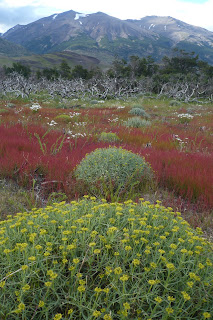
The hiking was incredible. We worked cycles of eleven days on, four days off. I myself worked two of the eleven day cycles, and hiked for four days. I also hiked in the evenings, and we did one early morning hike to the top of Cerro Paine Chico (in the back of the picture below). The yellow flower is Mullinum spinosum, and the red is Rumex acetellosa. This is a typical burned lowland.


The ascent of Cerro Paine Chico was our early morning hike. We started at 0120 and climbed by flashlight, and summited at 0510. This is a photo of another volunteer, Elias from Spain, at the top of Cerro Paine Chico with a nice view of the famous Torres Del Paine. The Cerro Nido de Condor, and a small piece of the Monte Almirante Nieto.


On my four days off, I did a nice hike to some parts of the park that I hadn’t yet seen before. This is a photo from my favorite part, the Valle Bader. From left to right, the mountains in the picture are the Cuerno Norte, La Mascara, La Hoja, and La Espada. The best part of the Valle Bader is that I didn’t see a single other tourist in there.


And this is the view coming down from Valle Bader, with the Lago Nordenskjold and a “fosforito” shrub in the foreground. A very nice place, and the Cuerno Este side has no trail at all.


This is another one of my favorite parts of the park – a small, easily accessed, and little-seen area to the South of Guarderia Laguna Amarga. Over there, I found interesting plants, rocks, animals, and even cave paintings.


.