Showing posts with label Kuwait. Show all posts

Thursday, October 18, 2007

Going home!

I'm almost home! It has been a long, tiresome process. We started by shipping all our stuff out of Kuwait, and moving out of our barracks. We spent over a day homeless, waiting for our flight out of Kuwait. This involved a lot of lounging around, drinking coffee and - for the more talented ones among us - playing poker or the guitar.


We then flew out to Mississippi, which was a long, uneventful flight. We did, however, stop in Ireland for a couple of hours. Many of our soldiers were very excited because they claim Irish ancestry, and as they walked around the airport giftshop they oohed, aahed, and commented on how good it feels to return to the homeland. Other people simply stood in front of the alcoholic drinks and stared as if hypnotized. We eventually left, although my friend Ian from Juneau briefly considered taking over the plane and returning to Ireland for good.


Mississippi was blissfully green and comfortable. We were there for about six days mostly to resolve paperwork, health and supply issues before going home. Of course, we had to endure another ceremony with dignitaries both military and civilian, but this one was mercifully short and I soon went back to meandering through the woods, where I found neat things such as armadillos, deer, Drosera sp. sundew carnivorous plants, beautiful tulip trees, skunks, turtles, and much more. It is a real treat to be overwhelmed by an ecosystem where the diversity is so great that it would be unthinkable to make an exhaustive list of everything I see from where I stand.


I am now in the Houston airport, waiting for a plane to Seattle, and I should be in Sitka within 24 hours. I just can't wait.

Saturday, October 6, 2007

A few things before leaving

Fifteen months after I reported for duty at the Sitka armory with a six-pack of beer in one hand and a duffel bag in the other, we're almost done with our deployment. Our replacement unit is trained up and in place, and all we have left to do is ship all our stuff out of the country, clean weapons, turn in equipment, do paperwork, etc...


Today was the award ceremony, that dreaded day where everyone lines up for trinkets. As always when we have formations, the weather was awful and the ceremony needlessly long. Two people passed out from the heat. Sergeant Metcalfe took the above photo. It is of specialist Hahn receiving an Army Achievement Medal from LTC Osborn, our battalion commander. This award is usually called AAM in the Army, and rates very low. Most people got AAMs and other puny awards. I was quite angry to find that most of the awards were very poorly written. Several people found out that they were credited for nothing in particular, had their names misspelled, or were credited with insignificant achievements. For example, mine states that I won second place in my weight category at a stairmaster competition, but not that I was a team leader or that I volunteered for the mission in Southern Iraq. One of the guys in my squad (I am a squad leader right now) even has someone else's name and achievements written into his paperwork. No wonder we didn't get any good awards!

On a more positive note - I found some flowers! Almost all the vegetation has been dead for months, but the Cornulaca leucacantha have remained mostly green, and they just flowered a couple of weeks ago (hint: look for yellow spots). Of course, it's not tulips or hibiscus, but you can't be picky in the desert after several months of zero precipitation.


And finally - a laughing dove Streptopelia senegalensis. They are flying through in large numbers right now, along with a few small flocks of turtle doves Streptopelia turtur. They are very easily frightened, so although they are rather common I never did get a good picture of one. I can't blame them; I'd probably be easily frightened as well if I were a defenseless bird flying through a country full of shotgun-toting Kuwaitis.

We're taking the internet satellite dish down in a few hours, and leaving Kuwait for good in a few days. Next stop: Mississippi!

Saturday, September 29, 2007

Ramadan mubarak!

I haven't had much time to do anything lately, thanks to a soldier who made a mistake while I was supposed to supervise him. The specialist - who shall remain unnamed of course - fired his rifle while attempting to clear the ammunition out of it.

Happens from time to time? It's okay, he was tired? I was just distracted? There's no such thing in the army. In fact, losing control of one's weapon in any form is the infantryman's capital sin.

So far we've both had about thirty hours of extra, which really isn't so bad but enough to deprive us of a bunch of sleep, and the final punishment hasn't yet been decided but it's looking like it will be unusually light (normally, rank and pay are taken away).
I haven't been bringing my camera most days, but I did get a few pictures anyways.

The birds have stopped dying off. It was fun walking around and pulling dead warblers, shrikes, egrets, quails, etc. , but it was also starting to get a little depressing. Now I see a lot of hawks, including a black-shouldered kite Elanus caeruleus, but mostly it is the same warblers, buntings, shrikes and wheatears as in the spring except that the numbers are lower. Also I made the mistake of shipping my field guide out with a bunch of gear. So the buzzards, pitpits, brown warblers, and eagles are all sp. I couldn't even put a name on the dozens of redstarts that showed up one day. Julien - do you know if this is just a colorful subspecies of the black redstart?


And I am pretty sure that this is a juvenile red-backed shrike Lanius collurio.


In other news, it is now Ramadan. I though about trying to observe Sawm for a few days, but it would be really dificult because I work a really long shift and the breaking of the fast (iftar) is right in the middle of my already insufficient sleep. Also, we don't get breakfast until after sunrise. Maybe after we're off mission. After all, it'll still be Ramadan until well into October.
The Kuwaitis are generally okay with us eating and drinking in the middle of the day while they themselves gradually fade away in the heat, but we try to eat and drink only when we are away from them. Public violations of Ramadan are explicitly prohibited by military regulations and Kuwaiti civil law, but most of us don't care about those ridiculous rules. It's usually better to informally enforce sensible conduct instead.
Thankfully, the temperatures have been going a little further down and the days are a little bit shorter, so this year's Ramadan isn't as bad as it will be in, for example, 2010 (in August!). My best Ramadan experience, so far, is chasing and catching the terrified ewe in this picture. She was later killed and cooked, but sadly I wasn't there for iftar so I missed the resulting meal.

Tuesday, September 18, 2007

We love our FNGs!

I guess I’ll have to explain that… In English, FNGs stands for “F*ing New Guys”.

Our FNGs are from Virginia, and they are coming to replace us so we can go home.

Finally! Of course, we still have to train them, swap our equipment, ship our stuff out of the country, fill out mountains of paperwork, check out through our mobilization station, wait for flights, etc. So it’ll take at least a month before we can look at life through the warming glow a glass of beer again.

I did a few good things recently:

I have been in country for over eleven months. Only one to go!

And finally, I won my “100 kilometer Club 2007” T-shirt this morning! That is a T-shirt that the run organizers give to those people who log in for 100 kilometers’ worth of organized races in the year 2007. It may sound easy, but between days where I miss a race because of work, days where I forget to sign up, and days where the run is canceled because of dust storms or because the mandatory ambulance is on a mission, it’s pretty hard to get to the 100 kilometer mark. I am the only one in the battalion who made the mark. My times are a little worse than they were last winter (5 kilometers in 18 minutes and 22 seconds this morning), but I am actually surprised not to have lost more weight and speed than I did over the summer.

I did an Army physical fitness test while wearing my body armor and Kevlar helmet, and carrying my rifle (except for the sit-ups, which I couldn’t do with a rifle because my fingers have to be inter-locked). The APFT consists of three events: push-ups for 2 minutes, sit-ups for 2 minutes, and 2-mile run.

I completed:

- 49 push-ups, versus 96 on my last APFT.
- 56 sit-ups, versus 80 last time.
- 2 miles in 14:14 minutes, versus 11:14 on the last APFT.

My total score was 232/300, versus 298/300 last time, with the Army minimum being 180/300, and a “perfect” score being 300/300. A perfect score corresponds roughly to being in the top 10% of the US Army.

So I still passed the test, but the extra weight really did take a serious toll.

As for birds, I have been seeing all sorts of interesting things but it was mostly on two dawn patrols, where I still hadn’t grabbed my camera and binoculars from the trunk of the Humvee. The best bird by far was a white stork (Ciconia ciconia), but I also enjoyed a few harriers sp., buzzards sp., black kites, a pratincole, and an eagle Aquila sp. I also found a few dead birds – the best one by far being a little bittern (Ixobrychus minutus). It is kind of cool getting to hold a tiny little heron.

Sometimes it seems that life has been really interesting for everyone except for me. Julien went touristing around Spain, and explored a cool giant cave in Southern France, Laurent saw the great bustard in Estremadura, and my dad went to the Pyrenees!

It appears that I haven’t been giving explicit enough information about my plans through this blog. As it stands, here they are:

- Spend a few days in Sitka in the fall. Go kayaking weather permitting (just thinking about it I get all excited).
- Go to Chile until sometime in January.
- Move to Juneau in early January.

- Re-start classes, again, for the spring semester.
- Depending on what fuzzy math method the counselors elect, I am about fifteen to twenty-two semester hours away from a BLA with emphasis in English and psychology.
- That translates into two more years of study for a four-year degree that is the equivalent of a really good high-school degree.
- As far as living arrangement, I’ll most likely be renting a room from Jad.

And by the way, who is Jad? Here’s a picture of him from the last time we shared accomodations:


Of course, we had a bit more room there than we will in his condo in Juneau... Jad’s a floatplane pilot, an infantryman, a former sailor in the Navy, a dad (as of this summer), and a good friend. He was my team leader on the Southern Iraq mission last spring. We both like to drink coffee and talk about random things, exchange books, etc. So this should be a stress-free arrangement. Of course, the best landlady in the world is still Noelle, but there just aren’t enough classes offered in Sitka for me to complete my degree there.

Tuesday, September 11, 2007

Illegal migrants turn themselves in to border police!

The birds are still suffering out here. Quails, in particular, have been willing to go anywhere for some shade. I had a quail fly into my Humvee and land right next to me, almost on top of the seat belt clip. Of course, it was trying to get some shade. The quail looked up at me, and I was absolutely stunned. I tried to catch the quail, but the bird looked really fragile so that when I had my hand on it I hesitated to grasp firmly, and it flew back out of the Humvee. Other quails flew under concrete blocks and in the shadow of building, and I could not catch or photograph them either. But I ended up getting a quail that flew into a Kuwaiti Police building and was caught by a Bangladeshi servant. I released it just before sunset, and got this picture before it flew off. Back in France, I don’t even remember ever seeing a quail although they are not rare, because they are usually well hidden in vegetation.


Since I was talking about vegetation, there is an interesting picture I thought I’d post. The natural habitat here is made up of very hard sand with a few perennials and many annuals that mostly dry up around May. However, most of Kuwait is heavily browsed by camels, goats and sheep, and driven over by all sorts of vehicles. By the time summer comes around, these parts of the desert will have been obliterated, and the sand gradually becomes soft at the surface. The fence in this picture was closed only a few months ago for tactical reasons, and already we can see a drastic difference between exposed and protected areas.


And here is another migrating bird that flew into the same Kuwaiti Police building. This one is a hoopoe, the bird I just cannot get tired of seeing and photographing. It is being held by a Kuwaiti Raqib, which is roughly equivalent to a staff sergeant in the US army. It takes about nine years to attain that rank from Shurtti - the lowest rank.


I have been reading a lot, and for variety I went back to reading in English. My most memorable reads of the last two or three weeks were:

Mala Onda, by Alberto Fuguet
If you lived here I’d know our name, by Heather Lende
The Shipping News, by Annie Proulx
El Tunel, by Ernesto Sabato

I really enjoyed The Shipping News, from which I had already read a few chapter in anthologies. The language is simply amazing, as in this passage:

“The sea. Heard a big one. She’s building a swell.” They stood below the amber sky, listening. The tuckamore all black tangle, the cliff a funeral stele.
“There. See that!” Yark gripped Quoyle’s wrist, drew his arm out to follow his own, pointing northeast into the bay. Out on the darkling water a ball of blue fire glimmered. The lighthouse flash cut across the bay, revealed nothing, and in the stunned darkness behind it the strange glow rolled, rolled and faded.
“That’s a weather light. Seen them many times. Bad weather coming.” Although the trickster sky was clear.


Although my main focus lately has been on improving my Spanish, I am looking to improve my English. For example:

- A “factoid” is not a fact. It would be a factoid to say that the Iranian government is a Sunni Muslim state.

- A name for duct tape is “Mississippi chrome”.

- I am going to standardize my quote marks, which I used to always put at the outside of punctuation.

Thursday, September 6, 2007

A tough time for migrating birds

It is still very hot our here - well over a hundred degrees F every day.

Whereas I have gotten disturbingly used to the heat (I even slept the entire afternoon in a humvee in the sun today), the birds are suffering and dying quickly. A "feldegg" yellow wagtail I found wedged between a cardboard box and a wall was dead less than an hour later. Under many parked cars there were dead shrikes, warblers, sparrows, and wagtails who hid in the only shade they could find but died anyways.

Still, there were some live birds. I even saw two species and one subspecies that I had never seen before. This one is the short-toed lark Calandrella brachydactyla. I found it panting under a car, but I was able to chase it out into the light where I could snap a picture of it. Other birds, especially the wagtails and warblers, remained firmly ensconced under cars.


This is one of the birds that just wouldn't budge, so the photo came out really strange. I posted it anyway because it is an other species I hadn't ever seen before: a River warbler Locustella fluviatilis. The legs appear pink because the light outside the car's shadow glows right through them:


I have always had a soft spot for pipits and wagtails, a family known as motacillidae. Whereas the two previous birds were new to me and rather unusual, today's best bird was by far a yellow wagtail Motacilla flava. Most of the yellow wagtails here are of the feldegg (the coolest-looking one) and thunbergi subspecies. This one is the first one I see of the beema subspecies. It looks a lot like the nominate subspecies that predominates in France, but it has a little white patch on the cheek:


And here's a bonus bird: the great grey shrike Lanius griseus. Apparently, this is the pallidirostris subspecies because its beak is mostly pale, and its lores are white. This one wasn't hiding under an object for some reason. He was doing his best to hold on to his barbed wire perch, and kept his eyelids closed because of the sand (I forgot to mention that the wind has been fierce lately, and everything exposed to it is constantly sandblasted).

Wednesday, August 29, 2007

Camel patrol

There are finally a few birds around! Just today I saw a quail, two great grey shrikes, four isabelline shrikes, five hoopoes, and a desert wheatear. I haven't had a chance to take any pictures yet, but hopefully by the next post I'll have a photo of some neat and unusual animal.

For this post I have some from a patrol where we stopped to check a Bangladeshi herder called Samir, and I ended up arranging some camel rides for the soldiers in the squad. We also got some camel's milk (although most of the soldiers were afraid of drinking something that didn't come with a USDA label), and I exchanged a few words with Samir. Surprisingly, he spoke a little Arabic and even a couple words of English. Most of the herders out here speak only Urdu, Hindi and other Indian subcontinent languages. This photo is of Samir telling the camel to rise up while Cañal hangs on for dear life:


And here is a photo of specialist Bates, who seems to think he is a méhariste (a French soldier specialized in camel warfare):


The French have a lot more experience fighting wars on camels than the Americans do. Whereas the American army never really got the hang of using camels and eventually abandoned or sold all the animals that had been imported, the French have a long history of using them for raids and regular operations. One famous méhariste is the French naturalist and adventurer Théodore Monod, who I really admire. This fun little interlude reminded me of him, and of how pampered we are here. He once crossed 900 kilometers of desert without a single water point! And many people around here think it is a big deal to run the 2 mile standard Army run!

One of my soldiers recently got hurt, and he won't be part of our operations anymore, so here's a photo I took of him on what turned out to be one of his last patrols:


Private Kirkpatrick, from Valdez, has been an infantryman in the Alaska National Guard for almost five years now. He had been trying unsuccessfully to pass the Army physical fitness test for the past year, but he'll probably never take one again. I was really angry when I found out he was too badly hurt to do any kind of work, because our missions are very easy and lacking in physical stress. I even got in a loud argument with the platoon sergeant, but in the end there was nothing I could do about it.

Friday, August 24, 2007

Herding camels, and raiding Plywoodtown

We've been here for over ten months without any problems, but it seems we haven't relaxed a bit. In fact, we now work longer hours, and we'll be doing more training too. So sleep will keep being a scarce commodity until October. We've been passing the time by chasing camels out of restricted areas, patrolling, drinking coffee, and talking for hours about how we hate everything about this place and we can't wait to have a cold beer in Alaska.

We did get to raid one of the plywood "training villages" that are scattered out in the desert. My squad, however, got stuck in a support-by-fire position and although we did get to see the enemy (people who get paid to play terrorist with Warsaw pact weapons), we didn't get to shoot. That's to be expected, however. In fact, most people involved in raids never even see the enemy, or if they do they won't be able to engage because we have to respect strict rules of engagement and sectors of fire. Here's my squad leader, a good sergeant who recently got back from Afghanistan, at the position from which he reported village activity to our maneuver element.


And here's my platoon sergeant, Sergeant First Class Shaw. He joined the Army during Vietnam, and was in the Special Forces. He was also in Iraq as part of the brigade that relieved the one I was with, which means he only got a few months' break between deployments. So why is he skylining himself and leaving a broken night vision bracket on his Kevlar helmet? Well, I guess he must be getting soft. In this picture, he is telling me and my M240B gunner to get ourselves and a ton of equipment up a soft hillside.


Wait... Did I say hillside? Don't be confused: there are no natural hillsides here. That was merely a 15ft high tailing. This place is completely flat, save for a few shallow open-pit mining areas. This is a picture of us exfiltrating trough such an area, using the tailings as cover and smoke as concealment.


Monday, August 20, 2007

Let's go downtown!

I got to go to Kuwait city again, which was a welcome break. The trip's stated purpose was to visit the aquarium, eat lunch, and visit the Kuwait Towers. I did those things and liked them, but by far I was happiest just walking along the seashore in civilian clothes, and looking for birds in the palm trees. Most of the birds were introduced species, such as the common mynah Acridotheres tristis, the domestic sparrow Passer domesticus, the white-cheeked bulbul Pycnotus leucogenys, and the collared dove streptopelia turtur. There were, however, a few laughing doves and hoopoes with the pigeons, and some terns and gulls offshore. Most of the birds were surprisingly skittish for a city. I am guessing that may have something to do with the hundreds of stray cats that live in the rocks along the seafront.
I really enjoyed the aquarium at the Scientific center. Of course, with a typical naturalist's fascination with strange creatures, I absolutely loved the cuttlefish, the bats, and the one lungfish they had stashed in a small tank behind a counter. I was pleasantly surprised to find that there were Kuwaiti students (from high school and college) who were volunteering their time as interpreters there. I was even handed a pet long-eared hedgehog by a couple of shy, hijab-wearing high school girls. As for the sharks, cute mammals and tropical fishes, well... They're so heavily promoted that they seemed rather like an extension of the giftshop to me.

I had an ungodly amunt of Lebanese food for lunch, and I had still had enough leftovers for an entire dinner after we returned to the camp. Then we went to the Kuwait Towers - again! It's a lot like the Space Needle, but smaller and surprisingly dirty for a national landmark in a country where labor is very cheap. The only advantage it has over the Space Needle is that it's by the Gulf, so I went beachcombing and found dozens of Dentalia shells. Dentalia are strange little mollusks that live in a shell like a hollow tusk, which is buried in the sediment. Contrary to what I long thought, they live with the pointy end out, and the wide end is where the "foot" (more of an anchor, really) comes out. In this photo, there is a small Dentalium at the bottom right.

Thursday, August 16, 2007

Not much new under the sun

The sun is still mercilessly beating down upon us, but it seems that we have largely gotten used to it. It seems wonderfully cool at 5:30 in the morning when the sun rises and it’s a mere 95º F. This is rather worrying, because we’re going to be miserable in Southeast Alaska in late October when the typical weather is cold, horizontal rain.

When on duty I've been having hours and hours of "jail time," where I just have to be around, ready for a war to start. I now routinely spend twelve to fourteen hours a day doing very little beyond just cooking in the heat while listening to radio trafic and watching the desert.

So I read. I just got done reading La Reina del Sur by Arturo Perez Reverte, and La Sombra del Viento by Carlos Ruiz Zafon - two Spanish writers I had never heard of before, but I guess they are famous. I really liked La Sombra del Viento, a literary mistery that takes place in post civil war Barcelona. It really reminds me of Jacques Tardi (a French cartoonist who tells stories set in the underworld of Paris), who also fills his stories with bizarre male characters, beautiful women, corrupt cops, empty streets where little-known landmarks are visited during misty nights and turn out to house evil creatures.

As for La Reina del Sur, I had high expectations for it because the author had great reviews on the internet and the book is about drug traffickers in Mexico and the Straits of Gibraltar. I loved the Mexican slang and drug world he evoked, but for a "thriller," it turned out to be rather run-of-the-mill stuff.


The migration is still picking up, very slowly. I saw a desert wheatear, and a dozen hoopoes (the Kuwaitis know the hoopoe well; they call it Hudhud). Right around 10:00 in the morning, the hoopoes started looking really distressed. I found this one in a small patch of shade at the foot of a border police building, where it kept wedging itself against the somewhat cooler wall and sticking its beak into the dirt. The hoopoe is still one of my favorite bird.


I feel that I don’t give enough credit to the people who are out here with me; it’s mostly because I have a hard time mentioning them without running into opsec problems (basically, I’d have to get vetted by military intelligence even for relatively mundane information). This guy is SPC Cagle, a Tlingit Indian who is in the same squad as me. Cagle is a really hard worker who has no fear of saying what he thinks. For that reason, he’ll probably never get promoted so I guess he’ll just keep being one of those under-recognized “grunts” who run the army from the only position that is truly indispensable – that of infantry rifleman.

Wednesday, August 8, 2007

Pratincoly nothing to report

We just got through a pretty bad heat wave. Although the high and low temperatures today are still a respectable 88 and 116 degrees Fahrenheit (about 30 and 47 degrees C), it feels quite a bit cooler than last week when the wind was really hot.

I ran the weekly early morning five kilometer race twice recently, with much tougher competition than before. I finished in the low 18 minute range as usual, while a couple of runners made it in under 17:30. I was glad these guys showed up, because otherwise I never would have mustered the motivation to run fast in 90 degree weather.

Upon finishing today's run, I was rewarded with a great bird: at first, I thought it was another white-winged tern, but it got closer and I realized it was a collared pratincole Glareola pratincola! What a beatiful bird! I thought about running after it to get a longer look, but I was already tired and it was flying fast.

More hints that birds are starting to move: I saw two hoopoes, several brown warblers that I couldn't positively identify, two barn swallows, and a few high-flying unidentified laridae.

I got three Economist magazines in a week, and since it takes me about six hours to read one issue, most of my reading time was taken up by those and the daily Sitka and Military newspapers.

I haven't taken a single picture in the last ten days but I feel somehow obligated to post one so here's an old one, of the common bush Astragalus spinosus. Its thorns are actually longer than its leaves!

Saturday, July 28, 2007

The things I did do during the past week

I have been trying to post something once a week at least, which makes me look back on what I did, what I read, what animals I saw, and so on… Even if I don’t write it all down because it is boring, classified, or too similar to something I did the previous week, it makes me feel better about myself. All right, I did do something after all!
The highlight of the previous week was reading Delirio, by Laura Restrepo. The book’s style is rather challenging, but I read it and enjoyed it. And I am really proud of my progress in Spanish. The story is divided between three (four, if we count the aunt) alternating narrations, but each one of them is mostly linear so that helps. The real challenge is this: what would normally be a paragraph is made into a sentence; what would normally be a chapter is made into a paragraph, and the whole novel is treated as if it were one chapter. Sounds weird? It is, but it is also surprisingly easy to get used to, and then I wondered why we insist so much on setting out dialogue, etc…

Here’s a random example:

Aguilar a duras penas logra pegar el frenazo para no atropellar al mendigo que
de buenas a primeras sale de la lluvia y se le atraviesa a su camioneta, Pero
qué mierda hace este loco suicida, por poco lo mato y el corazón me patea del
sobresalto pero según parece a él toda la escena le importa un bledo, simplement
hace parte de su rutina y de los gajes de su oficio, y sin que yo sepa a qué
hora ya está metiendo una mano por mi ventanilla mendicante, Dame para un
cafecito, hermano, que el frío está berriondo, me tutea como si … [sentence goes
on for another half page].

Condensed and roughly translated version:

Aguilar almost runs over the beggar, But what the hell is he thinking, I almost
killed him, and my heart is pounding but he doesn’t seem to care, it’s just part
of his routine, and now he’s sticking a begging hand in my window, Give me money
for coffee, brother, it’s cold, he tells me familiarly as if…

She does capitalize the would-be sentences, but the language still flows right past the comma simply because we’re used to moving on. Obviously, the biggest challenge is that there are three distinct voices crammed in there: the narrator, the beggar, and Aguilar. So it works, but I only think her technique is effective so long as it is unique.

I saw two gulls! The first one was a young slender-billed gull Larus genei in flight, and the second a summer plumage adult white-winged tern Chlidonias leucopterus. They both surprised me, since I am not really expecting any interesting birds for another month at least. I finally got some pictures of the desert foxes, but they aren’t so good so I’ll try again. I did, however, catch this neat pipistrelle-type bat (I know nothing about bats):


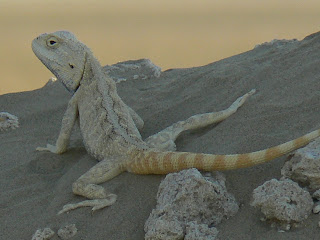
Then I solved the problem of the blue-less Trapeles persicus lizards. It is indeed the female that has no blue on the underside, and the male that does. Even on the male, though, the blue becomes hard to see when they are on the lookout for big predators like me, because they start to hug the ground and fold their throat pouch. I caught a female and a male, but I couldn’t take pictures of the male’s underside in my hand because he bit me really hard (he drew blood, actually). So here is the male after he bit me and I involuntarily gave him his freedom back:


And here is another cute Stenodactylus gecko. This one is called Stenodactylus doriae. He looks somewhat like Stenodactylus arabicus (which I also photographed in my hat), but yellowish and spotted, and more aggressive-looking.

Saturday, July 21, 2007

Kuwaiti foods, a few books, and the newspapers

Life has been rather eventless lately. I made several unsuccessful attempts at photographing the desert foxes that come out at night, and I caught another long-eared hedgehog a couple of nights ago. I’ve been reading books and newspapers to pass the time, and I’ve been getting more time to talk to the Kuwaiti border police personnel. I’m not even trying to improve my Arabic, since any progress I might make wouldn’t really be significant enough to make this mission much more enjoyable. Spanish is much more important to me at this point. I still have a long way to go until I am fluent in it, but not nearly as long as Arabic.


One of the advantages of spending time with the Kuwaitis is that their food is far better than ours. This is a light meals, in comparison to others that I have had. I still know a lot of food names, but I just make the Kuwaitis laugh with the Iraqi dialect I am used to. Some of the sergeants on the border now call me Abu Timmin, because I didn’t know that the Kuwaiti word for rice is ’Aysh, and I used the Iraqi equivalent: Timmin. From the American point of view they look like a bunch of uncivilized picnickers, but in fact there is a whole set of unwritten rules on how to handle each kind of food. I guess my table manners are bad by Kuwaiti standards. Oh well…

I just got done reading Mi País Inventado, by Isabel Allende. It was not a great book (informal, and too short), but it made me re-evaluate the other books by her that I read this year (Cuentos de Eva Luna, Hija de la Fortuna, Zorro, La Casa de los Espíritus, and Retrato en Sepia). What surprised me most is just how much of what she writes as “fiction” is actually straight from memory. I still get impatient when she has female characters act and think like upper-class, modern American women (such as a nineteenth century Chilean woman who opens a microcredit bank for poor women). However, I had to completely re-evaluate La Casa de los Espíritus and Retrato en Sepia, in light of the fact that they turn out to be almost all family lore.

I also got some interesting comments on Chilean society from this book. Some anecdotes are really funny, like one about a powerful landlord who used to say the following rhymed prayer after having raped the women on his property:

Señor, no fornico por gusto o por vicio, sino por dar hijos a tu servicio.
(Lord, I do not fornicate for pleasure or for vice, but to provide children who
will serve you)

I really wish she would just go ahead and write a people’s history of Chile. Her description of the late 1800’s expansionist war against Peru and Bolivia is extraordinary, and Zorro is unexpectedly full of neat descriptions of California, Spain and New Orleans in the early 1800’s.

According to the crown prince of Kuwait, the Amir is Father to all Kuwaitis, and he has “inherited from his honorable ancestors deep insight into the present with all its reality and, in tandem, exploring the future with all its dimensions and potential either on domestic or foreign policy at all levels.” I know, this is grammatically dubious, but this is exactly how it was reported in the Kuwait Times a few days ago. The original Arabic. probably sounded even more like a badly translated Hindu scroll. His deep insight decided that Kuwait needed a new weekend. Starting in September, Kuwaitis will get to rest Friday and Saturday, instead of the current Thursday and Friday.

Hey, if I had his abilities, I’d adopt a new weekend too: Tuesday through Sunday.

Nobody seems to mind the coming of the new weekend, since unlike the US where the weekend tries to encompass the Sabbaths of Jewish, Catholic, and Adventist traditions, here everyone that matters is Muslim, and there is only one sacred day of prayer – Friday. So the day of rest is just a recent addition, a western import. As for the imported labor that does 99% of the work in Kuwait, most of them never get a day off so they aren’t impacted.

I also learned about a really neat office in the Kuwaiti government: the “Supreme committee for the ideal mother.” Its chairperson is Sheikha Fareeha Al-Ahmed. She thinks Kuwaiti youths are corrupt because of insufficient satellite TV censorship.

Saturday, July 14, 2007

Things to do in the heat

It’s hot out here – REALLY hot. Not only does the sun beat down almost vertically on us, but the breeze is even hotter, and carries little sand particles that get in our eyes, nose, everywhere. Also, there is no natural shade whatsoever, no grass that might diminish the glare, no rain that might keep the sand down, not a single cloud that might occlude the sun for a short while.

The larks just stand out in the sun, beak open, looking stunned and forlorn. Only the dhub lizards seem to deal with the heat all right. As for myself, I just drink inordinate amounts of water, and I have to watch that I don’t step in and out of air-conditioned areas too much, because that makes me feel sick. In some places such as the command post tent, there’s a good fifty degree difference between inside and the afternoon heat. Going in and out of there makes me feel like I am being repeatedly kicked in the stomach. Jad says it’s because I’m skinny and I have low blood pressure. I think he’s right.

Since this is hopefully the hottest temperatures I’ll ever have to live in, I made a couple of experiments.

First, I ran along the base perimeter at 1700 one day, when the temperature was around 115 degrees F. I made it in 52 minutes and 25 seconds, which for the 6.5 mile distance is slow, but this wasn’t about speed. I stopped sweating around mile four, not because I had run out of water as Army doctrine says I would, but simply because my sweat glands were “turned off.” When I stepped into the air-conditioned gym tent, I started sweating profusely until my body temperature was back to normal, and then I stopped sweating even though I think I still had plenty of water in me. I didn’t get a headache (once again, the Army says I should have), and my skin was not particularly “cool and clammy.” The most disagreeable effect of the run was that my saliva turned into a white paste that was very similar to school glue, but thicker. After ten minutes of AC and a liter of warm water, I was back to normal. So I guess water loss isn’t as dramatic on the long-term as the Army says it is. I don’t know how long I could keep running without any water, maybe another hour or so before losing consciousness. Whatever it is, it’s way past the Army’s limit for hard work in extreme heat. I think I could get used to living and working out here without air conditioning, but it wouldn't be fun.

Second, I read about camel herders in western Sahara (not the country) who spend the hottest part of the day wrapped in wool blankets. I had indeed noticed that when the outside temperature is below body temperature, putting on my ballistic armor makes me hotter, but not as much when the outside temperature is greater than my internal temperature. I put on some long unused polypro underwear to a couple of patrols, and I didn’t really feel a difference.

The only proven remedies for extreme heat remain: going to Southeast Alaska and staying there, or entering an air-conditioned area and staying there. As a result, we’ve been waiting impatiently for the end of the deployment (less than a hundred days in Kuwait left!), and spending as much time inside as possible. Here I am, staying out of the heat:


I just love my computer – how did I ever get by witout it? It’s my post office, radio stations, shopping center, CD player, cinema, and everything else in a single small, relatively cheap, incredibly high-tech toy.

It’s simply incredible what is out there on the web nowadays. For example, I was just trying to by a GPS, and read a comment leading to a link that sounded funny. And of course there went several hours of my not-so-precious time following links from all over the world. I ended up on the blog of a Chilean author I had never heard of before! He writes about interesting books, critics magical realists (“Colombia, un país donde los ‘garciamarquianos’ o los ‘gabistas’ abundan como el café y la guayaba”), and even has some really interesting insights about my perennial dual language problem (he was born in California and moved to Chile when he was thirteen). One of them follows, written in English in the original:

“Yes. Some people believe there is such a thing as bilingualism. I have my
serious doubts. One can speak, even write in different languages, but one of
them must dominate. And in my case, by now, it's Spanish. I am a
Spanish-language author and, more important, a Chilean. In the United States
now, I have an accent. I stumble on spelling and, though I may talk all day in
English, at the end of the day, I will need to revisit things in Spanish.”

So I’m getting one of his books, along with the GPS receiver and some Chinese “Lapsang Souchong” smoked tea. I just can’t believe what is accessible to people almost anywhere in the world. Having grown up in Paris, it came as a matter-of-course that the world’s greatest paintings, libraries that could answer any queries, and any kind of music or food I might fancy, would be readily available. But now this is all easily accessed from my couch!

Thursday, July 5, 2007

Larks - as promised!

Yesterday was the fourth of July, but I didn't get to celebrate that. I had meant to run in the five kilometer fun run but I couldn't participate, so the fourth came and went like every other long, hot, boring work day in the desert. Actually, I did drink a non-alcoholic beer and eat a slice of pizza after my shift.


There still have been some reasons to celebrate a little. We've now been on active duty for a year - there are only about four months left to go for most of us. Why do I say "most of us?" The National Guard is always broke. If we can get sent to Army schools immediately after coming back from here, the cost of the school will be borne by the federal government, not the state.


Another reason to celebrate is that I finally got my promotion to sergeant, which had been promised to me loooong ago but the paperwork kept getting lost, filled out wrong, etc... So this is the "Sergeant Lost Frenchman blog," from now on! This year I was the number one infantryman for promotion to sergeant, so my chain of command put extra enrgy into the matter and the problems were worked out. Now I can boss everyone around! Actually, no. My job won't change, except that I'll be paid a tiny amount more and I won't have any more excuses for making mistakes.

Lesser people blog about Middle Eastern affairs, Washington conspiracies, and Paris Hilton. This blog post is about what really matters: larks.


Larks seem to be the only bird that can take the heat out here - whereas almost all the other birds are gone, larks have actually increased in numbers since it got really hot! There is something awesome and bizarre abut the fact that they spend the summer in this dry, hot, predator-infested inferno even though a fertile river valley is just a few hundred kilometers away. This one is my favorite, the hoopoe lark Alaemon alaudipes. The hoopoe lark is the biggest of the larks I see around here. It runs more than the other larks, and it has a really neat early-morning flight song ritual that I got to wake up to every morning while I was on southern Iraq missions.


Here is by far the most common bird around here: the crested lark Galerida cristata. Anyone can recognize it; it's the one with the crest. They are always around, but somehow I have been having a very hard time getting pictures of them. I got this picture by waiting for about an hour by a small mud puddle where a water truck had overflowed.


And this one is another very neat species - The bar-tailed desert lark Ammomanes cincturus. Okay, this particular one looks really worn-out and ragged, rather like a stuffed specimen Julien just pulled out of a dusty crate from an eighteenth century museum expedition. It was very much alive, though. Just hot, miserable, and more than due for a molt. This lark looks like a bleached, featureless female house sparrow when landed, but when it flutters about it is easily identified by its soft flight and rounded, ochre wings. Normally the bar on its tail is not as visible as in this picture. I see this lark quite often in places where there is not even a shrub in sight, and sometimes in small groups.

Finally, this is the desert lark Ammomanes deserti. Every time I see a desert lark, it looks different. I always have a hard time figuring out what it is, and every time I am disappointed by how dull the bird is. This one happens to look like a pipit with an unusually thick bill and no streaks, but generally they are just boringly and confusingly non-descript. Some are sandy or tawny, and some are grey like this one. The thick beak, dark above and pale below, and the soft flight are the only real identification criteria that have worked for me.

Then there is only one other lark I have identified here: the really cool black-crowned finch-lark Eremopteryx nigriceps. They got really close to me, but of course I didn't have my camera handy when I found them.

Saturday, June 30, 2007

Hedgehog and more

This adorable little critter is called Emiechinus auritus, or long-eared hedgehog. It was caught by some Kuwaiti border police personnel, and I "adopted" it for a day so I could snap some pictures of it in daylight before releasing it at night. In the end I was glad I kept it longer because it is quite friendly and several other soldiers got to hold it, play with it, get their picture taken with it and make up nicknames for it. I released the hedgehog in an anti-tank ditch the following night, but it was attracted by the lights of our position so about an hour later we found it again eating Anthia beetles in the middle of the road. Eventually, we decided to drive out into a dark area of the desert and leave it there. This is definitely the neatest animal I have seen since the amphisbaenidae worm-lizard. This long-eared hedgehog is smaller than the ones I found dead or heard about from other people who have seen them before, and its spines are much softer too, so I think it must be a young one.


I can already hear the comments: "What? Another reptile?" Well, I had been trying to take a picture of one of the beautiful, blue-throated Trapelus persicus lizards for a while, but they are very fast. I finally got some pictures of one, but it happens to be an individual without any blue coloration! Is it a female, or an abnormal individual, or even a diferent species? I don't know, but I am guessing that it would be a female (a couple of synonyms are Trapelus blandfordi, and Agama blandfordi). If nothing else, researching these reptiles I've been seeing has made me realize just how many fascinating species roam this area. And I did ask about the desert monitor. According to the Kuwaitis I asked, monitors are not eaten (it is the Dhub lizard that is widely eaten), but many people kill them because they are considered to be aggressive and dangerous. The Kuwaitis also said that the monitors live in large numbers in small territories, which sounds strange considering that I have yet to see more than two in one place.


I have been seeing rather high numbers of larks lately and I took a few neat pictures, so my next blog post will probably be dedicated to the three most common species: desert bar-tailed, hoopoe, and crested larks. Besides for those, the birdlife is rather dull right now. I haven't even been seeing any shrikes lately.

Overall, Kuwait is still the boring place it usually is. One of the questions I always get from Kuwaiti soldiers is: "Do you like Iraq?" I guess I am expected to say no, but I immediately think of trees, rivers, lakes, orchards, and local people who don't live like spoiled kids. So I just give a diplomatic answer like: "It is pretty, but dangerous." The saddest thing is that Iraq really isn't pretty unless I compare it to Kuwait or some similarly blighted area (parking lots under construction, Superfund chemical dumping sites, etcetera). And while I am on the topic of locals: a while ago I wrote about a cleric who issued a ridiculous fatwa about women having to breastfeed their male co-workers. A similar, but more serious, issue has been at the forefront of Kuwaiti politics lately: The Assembly recently passed an amendment to labor law, saying that women may no longer work from 8PM to 7AM. There are exceptions for health workers (there just wouldn't be anymore nightshift nurses otherwise), the two female ministers (who probably inserted the language themselves), and select people who might be fortunate enough to obtain government permission. As far as I know, the amendment has not yet been approved by the Emir.

Monday, June 25, 2007

Reptile fun III - desert monitoring

During my latest long shift of desert duty, I got to take a picture of yet another significant reptile of the local desert. The Varanus griseus desert monitor is a fearsome predator - a more fearsome predator, in fact, than even the Vulpes ruepelli desert foxes that walk around the desert at night on the prowl for gerbils and food scraps. Gerbils? Food scraps? Yes, the desert monitor will eat them, but he'll also eat everything else, too. That meter-long lizard will hunt and eat the scorpions, hedgehogs, dhub lizards, and even the vipers and black cobras that live around here. The desert monitor is endangered, and I have seen fewer in the eight months that we have spent here so far, than in the two weeks that I spent here on my way to Iraq in the early spring of 2004. I don't know exactly why their population is so clearly diminished, but I am planning to ask the local border policemen tomorrow. The locals call this lizard Wurral.


This lizard is one that I caught and photographed a few months ago, but since I've been posting so many reptile photos I thought I'd add this one. It is a gecko known as Bunopus tuberculatus. This particular one looks ragged because it was halfway through its molt when I found it.


Most of the other lizards I found were too fast to be photographed, or I snapped a picture and couldn't come up with a name for them so I didn't put them up on my blog. But I hope this gives a good idea of just how many neat reptiles inhabit this desert.

Friday, June 22, 2007

Solstice, and other pagan goings-on

Jad recently e-mailed me a BBC article about Stonehenge, which depicted how thousands of people stayed up through the night just to have the dramatic sunrise moment blotted out by an inopportune cloud. They should have come out to the desert instead! We've been having 100% cloud-free opportunities for pagan worship. This eclipse of Venus by the moon would have been really neat at any Druid's party (thanks, Jad, for waking me up so I could take a picture):


Also popular with the New-Age crowd is this sacred dung beetle, Scarabaeus sacer, or perhaps one of its very similar relatives like Scarabaeus semipunctatus. These sacarabs have been coming out at night on the border by the hundreds. It's hard to think of them as cool, exotic bugs anymore since I am always trying not to step on them. So far, I have seen them roll a dead gerbil on two occasions, but I haven't yet seen one with a dung ball. I did find and dig up two of their hatched nest burrows last winter, which did not even have dung ball shaped cavities. I am starting to wonder if they are mainly necrophage species around here, but I have yet to find one underneath a dead bird.


Thanks again for the great package, Noelle! Of course, with the summer solstice and all these Noelle-ish happenings, I should have guessed I would soon hear from you again.

Thursday, June 14, 2007

More fun with reptiles!

This viper is the classic reptile that we see on the border at night. I am hesitant to identify it, although it looks like a close relative of the desert horned viper. This particular one is about two feet long, which isn't terribly large but still probably adult size. I also caught one about half that size. These poor vipers are the target of constant hassling by everyone from civilians to Kuwaiti and US military personnel. They are routinely being run over by trucks, beat into the ground with miscellaneous objects, captured for sale to the Scientific Center in Kuwait City, and even shot. I feel a little badly about having caught them, but they would probably be dead by now had I not snatched them up.


This little guy may not be terribly unusual, but he definitely won the "cute reptile competition." He is a gecko known in Latin as "Stenodactylus arabicus," that my turret gunner caught. He is about as long as a finger, and a fairly fast runner. I was at first surprised to find out that he wasn't able to climb walls, but then again there are no naturally ocurring smooth vertical surfaces for geckos to climb around here. Instead, they have little hands that look a lot like human hands. This gecko is the most fragile-looking of the many species of small lizards I have found around here.


And the greatest reptile I have ever found is this one: a Diplometopon zarudnyi worm lizard. I found it while looking for buried sand boas. These worm lizards burrow so close to the surface of the sand that they leave a little raised track everywhere they go. By following these tracks to their end I can just dig around the sand and pull them right up.
Worm lizards are technically known as Amphisbaenia. Amphisbaenia are legless lizards that live underground and tunnel through the substrate to find small prey (arthropods, whatever is available). I got a lot of information from the webpage http://garaje.ya.com/aligatorjazz/amphisbaenia.htm, which is great but in Spanish. This species excavates its tunnel by moving its head from side to side, unlike its relatives which have shovel-shaped noses and move their head up and down, and those that have a recurved snout and swing and turn their heads. The only species that doesn't use only its head to dig is a Mexican one that has two tiny arms near its head and uses them to get the burrow started. To deal with underground life, worm lizards have a layer of clear skin over their eyes, a layer of keratin on their forehead, and their nostrils face back.

Sunday, June 10, 2007

Playing with reptiles

The three weeks since I last posted a blog entry have been entirely swallowed up by interminable hours of dreary shift work in the heat, and a move to new barracks where we just now got internet installed. The best things I have done in the past three weeks are:

- I read a few books in Spanish.
- I bought an airplane ticket to Santiago, Chile, for when this deployment is over (I am planning to be in Chile from early November until January).
- I put an eighteen inch “Dhub dhub” lizard in the commander’s desk.

“Dhub dhub” (or “Dhub,”) is the Arabic name of a sort of whiptail lizard that is extremely common around here. Its genus name, I guess, is Uromastyx sp. It is a pretty impressive lizard that is completely harmless. In fact, it lives rather like a tortoise, eating vegetation, drinking little or no water, sleeping and hibernating in burrows, living a long time and growing slowly. Rather unlike tortoise, however, Dhub lizard are very fast runners, and hard to catch. Some of us have been able to outrun them, but I haven’t caught one yet since I am not much of a sprinter. This one was caught by an undisclosed friend, and I took this picture after we fashioned a little leash for it out of parachute cord, and tied it off to my couch (yes, I have a couch!).


After dark, I managed to sneak into the commander’s area , remove some pens and supplies from his desk drawer, and replace them with the lizard. Sadly, the command post’s air conditioner is a true blast freezer, chilling the tent to a quasi-arctic 60 degrees F (it is eighty degrees F inside my room right now, and about 118 degrees F outside). This caused the lizard to go into hibernation inside the desk, so when the commander opened it the lizard didn’t leap out. The effect was still quite worth the effort – according to people who were there at the time, the commander almost fell backwards over his chair in fright. Here is another Dhub lizard – this time a baby that is being kept as a pet by a friend:


Speaking of reptiles… I think this is the Arabian sand boa Eryx jakayari. We caught it at night, in the desert. Its eyes and nostrils are located on top of its head, so it can lay buried in the sand and still be able to see and hear, like an alligator in water. Also like an alligator, it will wait for a prey to come by, and emerge at the last split second to pounce. Since it is a boa, it will then crush its prey like a constrictor, and swallow it whole. When we caught it, it got scared and coughed up a half-digested young gerbil. It is a very fast little creature that kept trying to get away from me, but after a few minutes of harassing it so I could get its picture it calmed down and I could just hold it in my hand.


As always, I have been reading the news. As you probably have heard, seen and read, there are a lot of tragic events in this region of the world and others. However, they managed to be trumped in my mind by the idiotic Fatwa of a Kuwaiti cleric.

Doctor Ezzat Attiya (yes, I am talking about a guy who has studied for many, many years) has recently put out a religious edict saying that in order for a woman to work in a place where there are men, she must breastfeed the men. Yes, that’s right! According to this highly trained genius, if a woman breastfeeds a man, he will become her son in the eyes of God, and the man will stop having sexual thoughts about her. And no, he didn’t say that breast pumps were authorized for that purpose by Allah. In my neophyte opinion, that shows precious little knowledge of the male psyche and a worryingly low opinion of his deity’s intelligence. More worrying: the guy is in effect a government employee, because his university is part of a mosque, and all Kuwaiti Sunni mosques fall under the ministry of Awqaf and Islamic affairs. It is kind of funny to ponder some problematic scenarios, such as: what about royal family women who are government ministers? What about women who cannot produce breast milk? What if a woman ends up marrying a coworker after he has been declared her son?