Saturday, November 14, 2009
Tuesday, April 7, 2009
Early spring in Sitka
This is the very, very common species in this time of the year, the Glaucous-winged gull Larus glaucescens, photographed from my kayak in Eastern Channel:
This is a picture of mid-altitude forest on Mount Verstovia (it is really hard for me to take pictures of the forest):
On that same hike, a higher spot on the base of Arrowhead Peak, this picture helps understand why mountain hemlocks Tsuga mertensiana grow into krumholz shapes in the alpine area:
This is as far as I made it that day, up to the final traverse. I hadn't brought my crampons so I had to turn around:
And this is what invariably happens when I tell myself "I shouldn't need my snowshoes today..."
This is a scenario within the "Wilderness First Responder" course that I took this spring:
.
Monday, September 29, 2008
Mongolia post #2: hiking
First of all, I found a 400ft high slanted slab of marble which made for great and relatively safe rock climbing practice:

This is the view from the top edge of the slab, with Sergeant Dirkes passing through a notch:

On top of most mountains, and along many roads, there are obo, a sort of cairn which have a pole in them, with some Tibetan prayer flags attached to the pole. Whenever we come by one, it is customary to walk around them three times and add a stone to the pile.

Most striking was the vastness of the terrain, so that I was only able to get anywhere after work by running for an hour or two at a time. I felt perfectly safe, since the people there are extremely friendly and always willing to take in a guest. As a result of the size of the place, almost everyone travels by horseback or on motorcycle, and sometimes in 4X4 cars.
.
Sunday, June 8, 2008
Time flies when you're having fun!
I also photographed this dwarf dogwood Cornus canadensis:
And this mountain hemlock Tsuga mertensiana, which is one of my favorite trees:
Here is another bear photo from work:
And a seventeen-pound king salmon caught near Long Island:
I also ran the Medvejie half-marathon, and won it in 1:23'07''. It was a good run, very scenic, mostly on dirt road, and it even got exciting when the safety guy on his bicycle had to chase a brown bear off the course.
Monday, February 4, 2008
Enough snow!
I thought my nose was going to freeze off on that one hour mini-adventure.
I then went back up the side of Mount Juneau to look for the goats, with Ian and Mac. It was a fun hike even though I was not wearing crampons and I kept sliding. I just tried to stay off the ridge where it was most icy and dangerous. The photo below is from the bottom of the trail that we started from. Ian and Mac are standing in front of an old gold mine tunnel.
I went back to Mendenhall flats, and once again I was absolutely freezing. This time I didn’t see any unusual birds at all, so I just walked around in the snow with Ian.
Most of my time is taken up by school, though, and some of my classes are very interesting. In decreasing order of interest they are: introduction to oceanography, history of the US II, Spanish conversation, literature and the sense of place, poetry studies. Of course, it isn’t so much the topic that makes a class more interesting than another, as the instructor and material.
And Jad – the pilot who owns the place that Ian and I are sleeping on - just got back this morning. For Ian it is bad news because now he has to sleep on the couch. As for me, I hardly know anyone in Juneau so I am happy to have another familiar face around. So far I only know a handful of Army buddies, and Roman, another Sitka “expatriate.”
As far as long-term plans are concerned, I have some vague ideas which are subject to change of course. I am planning to go to Sitka over spring break (late March) and look at perhaps finding a chunk of land that I could buy. Of course, everything there is VERY expensive, so I may or may not be successful in that particular endeavor.
Tuesday, January 22, 2008
Schoolwork and a little bit of sunshine
First, I went to a couple of beaches with Ian and Mac. It is a bit strange to go to the beach when there is snow on the ground, but I really enjoyed it. I even found a few ferns. I am looking forward to start studying botany when there are more plants around.
I then went for a walk out the mudflats by the airport. I didn’t see any rare birds (apparently, there might be a McKay’s bunting out here), but I did find some brant and a shoveler, although they shouldn’t be here in the winter. I was also very, very lucky to see a pod of orca whales out in the distance, just beyond a group of scoters that I was unsuccessfully trying to identify. I also took the mandatory bald eagle photo. Yes, I am a little sick of bald eagle pictures, but after all – they are pretty cool looking.
I then went with Mac to look for mountain goats on the side of Mount Juneau. It was quite a fascinating trip. Mac knows a lot about the local area (he grew up here), and about the mountain goats (he's been paying close attention to their movement for a long time). Mountain goats are - to my surprise - mostly a forest-dwelling animal here. They spend most of the year in forested slopes close to cliffs over which they can escape. It was odd to see mountain goat tracks, feces, and sleeping spots all over the forest, and to need crampons to negociate ice-covered ridges in the trees!
.
Tuesday, January 8, 2008
The Chile trip is officially over :(
So after I left Torres del Paine, I took a six-hour bus trip to Punta Arenas (the largest city in the region), and then a thirty-some hour bus trip to Valdivia, where I just walked around, drank excellent local beers, and ate a fish that made me horribly sick for a couple of days. My next destination was the Cajon del Maipo, but by the time I got there I was just too weak to do any high-altitude hiking so I went to Santiago to relax for my last few days. In the end, the bus trip was basically just a long exercise in suffering. The only upshots are that I saved a lot of money by not flying, and that I saw the Coscoroba swan and the lesser seedsnipe during a maintenance stop in the middle of the pampa in Argentina.
Santiago is, well, a big city. I spent a lot of time walking, drinking coffee, reading, and taking advantage of cultural activities such as museums, street performers, a representation of "Twelfth Night" in Russian with subtitles in antiquated spanish (my first play with subtittles - very odd), literary cafes, etc. But I missed the simplicity of my volunteering days, people were just not very friendly, and even in the city "green belt", drinking untreated river water was just out of the question.
I then went to Valparaiso because I was feeling better and well, it's a mythical city after all, I just couldn't miss it. Valparaiso was indeed quite fascinating, with lots of interesting people and things to do. There was even a little of birding to do, with inca terns and grey gulls in the harbor. I went to see a free puppet show at Neruda's house , which was by far the best live show I have seen during this entire trip. The kids in the audience were half the fun, as they kept talking to the characters and the artists who would talk back, shift roles, and exploit zones of ill-defined identity (for lack of a better term). For example, the character of the devil exists, and doesn't exist, inhabits other puppets, and then tells the kids that the devil doesn't exist - it's just a character some puppeteers chose to represent evil. But then again, as the kids will tell him loudly - he obviously is the devil!
I also went to Viña del Mar, and to see natural stands of Ocoa palm trees.
On my last day, when I had finally recovered some strength and appetite, I went hiking in Parque Nacional La Campana near the charming town of Olmue, where I made a light and fast (2.5 hours to the top) ascent of Cerro La Campana, a rather unimpressive 1800 meter mountain (1400 meters from the base) that is mostly known for having been climbed by Darwin.
Tuesday, January 1, 2008
Parque Nacional Torres Del Paine (1 of 3)
One is about park itself, one about the work with AMA, and one about the wildlife. That should work.
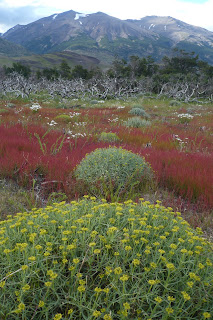
The hiking was incredible. We worked cycles of eleven days on, four days off. I myself worked two of the eleven day cycles, and hiked for four days. I also hiked in the evenings, and we did one early morning hike to the top of Cerro Paine Chico (in the back of the picture below). The yellow flower is Mullinum spinosum, and the red is Rumex acetellosa. This is a typical burned lowland.
The ascent of Cerro Paine Chico was our early morning hike. We started at 0120 and climbed by flashlight, and summited at 0510. This is a photo of another volunteer, Elias from Spain, at the top of Cerro Paine Chico with a nice view of the famous Torres Del Paine. The Cerro Nido de Condor, and a small piece of the Monte Almirante Nieto.
On my four days off, I did a nice hike to some parts of the park that I hadn’t yet seen before. This is a photo from my favorite part, the Valle Bader. From left to right, the mountains in the picture are the Cuerno Norte, La Mascara, La Hoja, and La Espada. The best part of the Valle Bader is that I didn’t see a single other tourist in there.
And this is the view coming down from Valle Bader, with the Lago Nordenskjold and a “fosforito” shrub in the foreground. A very nice place, and the Cuerno Este side has no trail at all.
This is another one of my favorite parts of the park – a small, easily accessed, and little-seen area to the South of Guarderia Laguna Amarga. Over there, I found interesting plants, rocks, animals, and even cave paintings.
Tuesday, December 4, 2007
¡Patagonia!
From Chiloé I went back to the mainland, to Puerto Varas for just a day, and then down to Puerto Montt, where I took the ferry to Puerto Natales in Southern Patagonia. I just couldn´t resist the temptation of a three-day ferry ride through the islands of southern Chile. (Et oui, Joseph, pour repondre à ta question, tu devrais retourner et prendre le Navimag. Je crois que ça va bien te plaire. Aussi, envoie-moi ton adresse et je vais t´envoyer ton bouquin). I rode the ferry “Magallanes,” which was up until recently known as the “Evangelistas” as is still written on the boat and the life rings.
The “Magallanes” is not a pretty boat, but it did the job rather well. Most of the trip was flat water, except for an eight-hour crossing of the Golfo de Penas where we encountered some oceanic swell that tended to slam into the bow. The majority of the passengers was tourists, so at times it felt a bit like a floating youth hostel, which was not necessarily a bad thing. The ferry never deviated its course for marine mammals, so I couldn´t identify for sure any of the ones I saw, but it did make a side trip to the PioXI glacier, and I saw lots of good pelagic birds such as the black-browed albatross (very numerous), pink-footed shearwater, Chilean skua (one of the McCormick´s species), southern giant petrel, southern fulmar, cape petrel, and best of all, three royal albatrosses! The route was very beautiful, but the gigantic scale of the mountains and islands, and the windy, rainy, cloudy weather made almost all photography efforts ridiculous. This is a small village in the Patagonian islands – our only stop between Puerto Montt and Puerto Natales (can you tell I like the boats here?).
This is going to be long… I then went into Parque Nacional Torres del Paine, where I hiked a 5-day circuit that took me around the back of the mountains, but not in the more heavily visited valleys. Once again, everything is enormous, and about half of my pictures are of little things like flowers.
And yes, of course, there are interesting birds here as well. Lots of condors, magullan geese, ashy-headed geese and nandús, but also some Chilean flamingo, Magellanic tapaculo, black-chested buzzard-eagle, cinereous harrier, dark-faced ground-tyrant, Magellanic woodpecker, Magellanic oystercatcher (notice a trend yet?), etc… And outside the park, there are guanacos everywhere. They are just incredible! The best part is that I get to observe very cool behavior, such as an owl flying about and looking at me, a pair of Magellanic woodpeckers peeling a dead tree just a few meters away, rayaditos in their nests, a fire-eyed diucon scrubbing a huge, hairy caterpillar on the ground before eating it, Magullan geese with their chicks, etc. I hardly ever needed binoculars, as most birds didn´t seem to care that I was there. Oh, and the Nothofagus forests were amazing, and there were many species of cool plants. Julien would have loved it.