Showing posts with label Birds. Show all posts

Tuesday, May 25, 2010

More random pictures of mountain life

Rock ptarmigan


Loiseleuria procumbens - Alpine azalea


Saxifraga eschscholtzii - Ciliate saxifrage


Ranunculus cooleyae - Cooley's buttercup


Gray-crowned rosy finch

Monday, May 10, 2010

Photos from our latest kayaking trip

Dunlin


Brown Bear


Semipalmated plovers


Lesser yellowlegs


Whimbrel


Wandering tattlers


Rock ptarmigan


Rock ptarmigan


.

Monday, September 21, 2009

List of the Birds of Titicaca / Lista de las Aves del Titicaca

I decided to use Google Doc as a test for one of my classes, and here is a worthwhile text for that application: the two-part list of the birds of the Reserva Nacional Del Titicaca, which I made last winter (boreal winter, that is):

Part 1

Part 2

And here's the paper I wrote about that:

Informe de Voluntariado RNT

Monday, September 14, 2009

Some Mexican birds

Okay, so I am incredibly far behind. I'll just blame this crazy summer for my delays in updating this blog. Now that fall is upon us and things get dreary, it's easier to find time to do this chore, but it's also a little sad to think back. Here's some birds - that's pretty fun and harmless. How about we start with the bat falcon Falco rufigularis?


If you've ever been wildlife-watching in tropical rainforests, you'll know just how incredibly hard it can be to see anything at all, and to know what you're looking at. Toucans, at least, make it easier by hanging out in clearings and making funny noises. This is Ramphastos sulfuratus, the keel-billed toucan.


And then, the tropics are also filled with birds from genera that I don't even know exist. The yellow-throated clorophonia, for example, may have been a beetle for all I knew. It turned out to be a cool little bird of the understory, Euphonia hirundinacea.


And this woodpecker is more of a variation on a familiar theme. The lineated woodpecker Dryocopus lineatus, looks much like the pileated woodpecker, except for its streaked chest and white stripes on the back.


Here's another very tropical bird, the red-legged honeycreeper Cyanerpes cyaneus.


This one is pretty common and familiar, but usually they've eluded me throught the tangle of vegetation. It's the groove-billed ani, Crotophaga sulcirostris.


.

Saturday, May 16, 2009

Some mesoamerican critters

I have seen just a few interesting animals, as I have only been in Guatemala for a week so far, and most of it has been dedicated to studying spanish at the Escuela de la montaña, about one hour down from Quetzaltenango.

This is the white-throated magpie-jay, Calocitta formosa.


Actually from the Reserva Biológica Huitepec, in Chiapas, this is the slate coloured solitaire, Myadestes unicolor. Most of the birds are impossible to photograph as they reside in the canopy, like the mountain trogon, or they hide in the low plants, like the quails and wrens (although the band-backed wrens act and sound like flocks of angry magpies).


I just came back from a trip to the Finca Santa Anita la Unión, a community of former guerrilla members, where I got to see one of the few remaining Ceiba trees remaining in this part of Guatemala. A quick look at the trunk will explain why they are almost extinct here.


This is a Dendrobates - looking tree frog, that I caught in the school's garden last night.


And this mushroom I found in Chiapas brought back some memories. It looks just like Geastrum striatum, a cool and common fungus in France.


.

Sunday, May 3, 2009

A few spring birds

Ahh, springtime...

This is a great time for birding, though I've been rather lazy about it, simply peeking at ducks on the lake from my living room window, and taking pictures of these marbled godwits, Limosa fedoa as I relaxed in the sun on the Taigud Islands.


There have been a lot of greater yellowlegs Tringa flaviceps lately. I like to think that some of those are the same ones that I watched (and heard, most conspicuously) at Lake Titicaca a few months ago.


I love the call of sandhill cranes Grus canadensis:
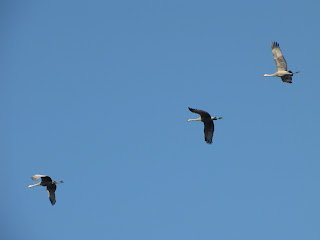

And everyone loves the common loon Gavia immer. In fact, some people love it enough to call it by its more dignified, British name: the great northern diver. I heard them sing several times during my latest kayak-based foray.


This snow goose Chen caerulescens hung out in town for a while, and was photographed by everyone (often with cell phone cameras). It was even featured on the front page of the local paper, in a wonderful photo by James Poulson.


This merlin Falco columbarius was nice enough to kill an American robin right in front of the Seven Fathom Bay Cabin while I was reading my book in it. The only reason the photo isn't perfect is that the windows were dirty, which is my fault.


A neat perspective of the head of a raven Corvus corax.


More greater white-fronted geese, Anser albifrons.


And a late common redpoll, Carduelis flammea, eating birdseed that should have been removed weeks ago, when the bears were starting to come out.


.

Tuesday, April 7, 2009

Spring kayak trip

Not everyone goes kayaking in this time of the year, but it can be pretty fun. This first overnight trip of the year was supposed to go from South Sitka to Brent's Beach and back, but we ended up getting hit with some wind, and came back to the North end of the road via Olga Straits, for a trip total of about 28 miles.

This is a whiteout in Krestof Sound, with so much snowfall at times that it formed polygons in the calm spots. My kayak is actually yellow on top, but it was thickly covered in snow at that time:


This is a great-looking Stimpson's sun star Solaster stimpsoni - a species that usually looks like a limp rag:


This is Brent's Beach cabin, on Kruzof Island:


Kamenoi Beach, with Cathy collecting seashells for her artwork:


The humpback whales were pursuing herring, so although they got pretty close at times, they were less predictable than late summer whales:


Cathy even liked paddling in the snow.


And this is a bald eagle, of course, on a rock south off the Kasianas:


.

Early spring in Sitka

I have been very, very lazy about updating this blog, because it is so much easier to just send a couple of e-mails and upload some photos to my new facebook account. It turns out that however convenient the facebook thing may be, it remains a temporary repository for inconsequential information, so I will attempt at catching up.

This is the very, very common species in this time of the year, the Glaucous-winged gull Larus glaucescens, photographed from my kayak in Eastern Channel:


This is a picture of mid-altitude forest on Mount Verstovia (it is really hard for me to take pictures of the forest):


On that same hike, a higher spot on the base of Arrowhead Peak, this picture helps understand why mountain hemlocks Tsuga mertensiana grow into krumholz shapes in the alpine area:


This is as far as I made it that day, up to the final traverse. I hadn't brought my crampons so I had to turn around:


And this is what invariably happens when I tell myself "I shouldn't need my snowshoes today..."


This is a scenario within the "Wilderness First Responder" course that I took this spring:


.

Wednesday, March 11, 2009

One more ovenbird?

I just went over some Furnariidae of Lake Titicaca National Reserve a couple of blog posts ago, and this may be another one:


The photographer (and biologist) David Pineda thinks that this is Geositta punensis. I think he is probably right, although the beak is somewhat long and the upper part of the outer rectrices aren't very obvious.

Saturday, January 31, 2009

Some Furnariidae of lake Titicaca

Here is an interesting family, whose members at times think they're Motacillidae, or Paridae, or other fun songbird groups.

This is Upucerthia jelskii, the plain-breasted earthcreeper:


This one is called Leptasthenura andicola, the andean tit-spinetail:

These two birds (look closely) are the always heard, not always seen, totoreros. In english, they are boringly know as wren-like rushbirds. In Latin, they are even more boringly known as Phleocryptes melanops:


This cool bird is a slender-billed miner, Geositta tenuirostris:

Helpful hint: it's called a miner because it builds in tunel-like cavities to nest in.

Another miner, not a cool but important, the rather lark-like common miner, Geositta cunicularia:

The very common Cinclodes fuscus:

And the much less common Cinclodes atacamensis:


One of two common species of Asthenes, the cordilleran canastero Asthenes modesta:
I hope I am doing a good job of conveying the diversity of the Lake Titicaca avifauna.